The RevLab Guide to the ESP32: Everything You Knew and Loads You Might Not Have
*NeanderPaul’s Go to Microcontroller* The ESP32 – the tiny, powerful microcontroller that can handle Wi-Fi, Bluetooth, sensors, and more. Whether you’re building IoT devices, robots, or wearable tech, this guide covers everything you need to know, from specs and modules to hidden tricks and real-world applications.
1/28/20263 min read

The ESP32...
Is one of the most versatile microcontrollers around. Think of it as a tiny, fully functional computer that can run your code, talk to sensors, and connect to Wi-Fi and Bluetooth all at the same time. It’s widely used in IoT, robotics, wearables, and DIY electronics projects because it packs so much power into a small and affordable package.
Unlike its predecessor, the ESP8266, the ESP32 has dual cores, more memory, and built-in Bluetooth, making it suitable for more complex projects. It has GPIO pins, analog and digital inputs, PWM outputs, and even capacitive touch pins, giving makers the flexibility to connect motors, LEDs, sensors, and other hardware without extra components. Its built-in sensors, timers, and low-power modes make it a complete solution for both hobbyists and professional IoT developers.
ESP32 Variants
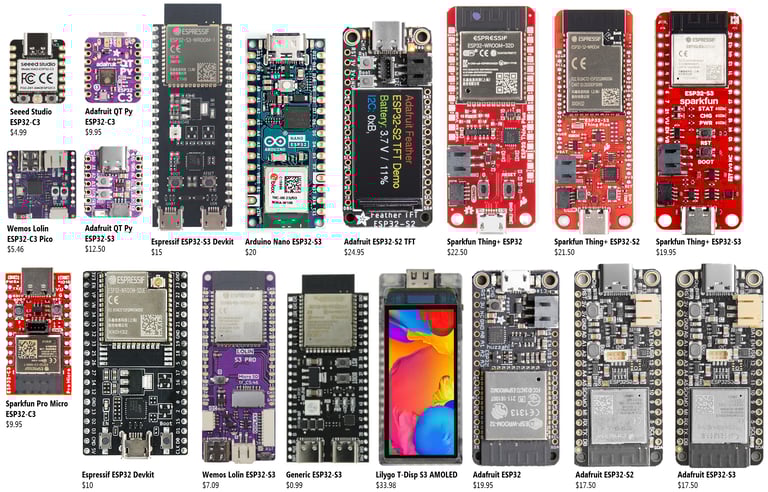
There are many ESP32 boards and modules, each with slightly different features. The ESP32-WROOM-32 is the most common and versatile module, suitable for most projects. The ESP32-WROVER adds extra RAM and optional PSRAM, enabling you to handle images, audio, and other memory-intensive tasks. Some newer models, like the ESP32-S2, S3, and C3, offer single-core processing, USB support, AI acceleration, or ultra-low-power features for battery-operated devices.
Specialized boards like the ESP32-CAM include a built-in camera for vision projects, while the ESP32-Sense series focuses on touch and environmental sensors. Keep in mind that not every board exposes all pins or features, so it’s important to check the datasheet before wiring up your project.
Programming the ESP32
The ESP32 is very flexible when it comes to programming. Beginners can start with the Arduino IDE or PlatformIO in C++, while advanced users can use Espressif’s ESP-IDF for full control over hardware features. MicroPython and CircuitPython let you program in Python, which is perfect for rapid prototyping, while Espruino lets you use JavaScript. One standout feature is OTA (Over-the-Air) updates, which let you update firmware wirelessly, super handy for hard-to-reach projects.
Key Hardware Features
The ESP32 is loaded with features you might not realize:
Ultra-low-power sleep modes allow months of battery life for small sensors or wearables.
Capacitive touch pins can be configured as buttons, sliders, or gestures.
PWM outputs allow precise control of motors or LED brightness.
Built-in hall sensor and temperature sensor for basic environmental sensing.
Timers and Real-Time Clock (RTC) for precise task scheduling.
Some variants support USB OTG, enabling peripherals without an additional microcontroller.
ESP32 Technical Specifications
Processor: Dual-core Tensilica Xtensa LX6 (some single-core variants)
Clock Speed: Up to 240 MHz
RAM: 520 KB internal, optional PSRAM up to 8 MB
Flash Storage: 4–16 MB (module-dependent)
Wi-Fi: 802.11 b/g/n (2.4 GHz)
Bluetooth: 4.2 BR/EDR + BLE (some modules up to 5.0)
GPIO Pins: 30–39, depending on module
ADC: 12-bit, up to 18 channels
DAC: 2 channels, 8-bit
PWM Channels: Up to 16
SPI/I2C/UART: Multiple hardware interfaces
Capacitive Touch: Up to 10 pins
Timers: Multiple hardware timers, including watchdog timers
RTC: Integrated real-time clock
Power Supply: 3.0–3.6V (some modules accept 5V with onboard regulation)
Current Draw: Active 80–240 mA, deep sleep ~10 µA
Package Size: Varies by module, e.g., WROOM-32: 18 × 25.5 × 3.1 mm
Power and Connectivity
Most ESP32 boards run on 3.3V, but many have regulators to accept 5V safely.
Wi-Fi and Bluetooth can run simultaneously, but Wi-Fi spikes power consumption.
Antenna options include onboard PCB, external, or IPEX connectors.
Use good grounding and decoupling capacitors to improve Wi-Fi stability and reduce sensor noise.
Projects You Can Build
IoT Devices: Smart lights, thermostats, and weather stations
Robotics: Motor control, sensor feedback, automation
Wearables: Heart rate monitors, data loggers, notifications
Wireless Cameras: ESP32-CAM for security or facial recognition
Bluetooth Audio: Wireless speakers or intercom systems
Hidden Tricks and Advanced Features
Dual-core multitasking: Run networking on one core and sensors on the other
ESP-NOW: Communicate with other ESP32s without Wi-Fi networks
DMA (Direct Memory Access): Fast data transfer without using the CPU
PSRAM: Handle large images or audio files
Capacitive touch gestures: Swipe or multi-touch detection
OTA Updates: Update firmware wirelessly, even when deployed
Why People Love the ESP32
The ESP32 is powerful, cheap, and flexible. It can run Wi-Fi, Bluetooth, and sensors simultaneously, making it ideal for DIY projects, IoT devices, robotics, and wearables. Whether you’re a beginner or an experienced maker, mastering the ESP32 opens the door to almost anything in electronics. Its massive community and ecosystem make troubleshooting, learning, and building projects much easier than other microcontrollers!